The World Health Organization’s (WHO) Global Tuberculosis Report 2024 delivers a sobering message: Tuberculosis (TB), long regarded as a disease of the past, has reclaimed its place as the world’s deadliest infectious disease—overtaking COVID-19 and HIV/AIDS. According to the report, 1.25 million lives were lost to TB in 2023 alone, underlining the urgent need for renewed global commitment and investment to combat the centuries-old illness.
Despite decades of medical advancement, TB remains a persistent threat—especially in low- and middle-income countries. Over 10.8 million people developed active TB in 2023, a slight increase from previous years, with India, Indonesia, China, the Philippines, and Pakistan accounting for over half of the global burden.
A Slow Recovery from COVID-19 Disruptions
The COVID-19 pandemic had catastrophic ripple effects on TB services worldwide. Lockdowns and resource diversions led to reduced testing, delayed diagnoses, and disruptions in treatment. While 2023 saw signs of recovery—8.2 million new cases were diagnosed, a record high—these included a backlog of previously missed diagnoses.
“COVID-19 pushed TB response back by several years,” said Dr. Tereza Kasaeva, Director of the WHO Global TB Programme. “Although we’ve made progress since then, the pace is too slow. We must translate political declarations into decisive action.”
Notably, the gap between new TB cases and reported diagnoses shrank to 2.7 million—down from 4 million during the pandemic peak. However, substantial numbers of people remain undiagnosed and untreated.
Deaths Falling, but Challenges Remain
The death toll has started to decline, reversing the upward trend seen during 2020 and 2021. In 2023, an estimated 1.25 million people died from TB—down from 1.32 million in 2022 and 1.42 million in 2021. This decrease was most significant in the WHO African and European regions, where deaths fell by 42% and 38%, respectively, compared to 2015.
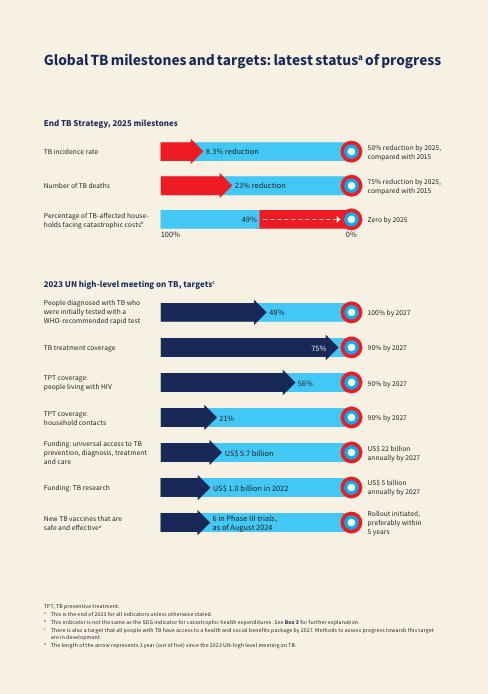
Despite these gains, the global community is far from reaching the 2025 End TB Strategy targets of a 50% reduction in TB incidence and a 75% reduction in deaths. As of 2023, only an 8.3% drop in incidence and a 23% decline in deaths had been achieved globally since 2015.
The Cost of Survival
One of the report’s most striking revelations is the financial burden TB places on households. Around 50% of TB-affected families face “catastrophic costs” — medical expenses, transportation, and income loss exceeding 20% of their annual household income. These economic pressures often lead to treatment abandonment, increasing both mortality and transmission risks.
WHO emphasizes the need for universal health coverage (UHC) and stronger social protection systems to ensure equitable access to TB services. Without addressing these economic drivers, ending the TB epidemic will remain out of reach.
Drug-Resistant TB: A Growing Crisis
Another pressing concern is multidrug-resistant TB (MDR-TB). In 2023, 400,000 people developed MDR or rifampicin-resistant TB. However, only 44% received appropriate diagnosis and treatment. While treatment success rates for MDR-TB improved to 68%, it remains significantly lower than the 88% success rate for drug-susceptible TB.
Experts warn that unchecked drug resistance could unravel decades of progress and exacerbate the already formidable threat of antimicrobial resistance worldwide.
Progress on Prevention and Research
Preventive treatment (TPT), especially for people living with HIV and household contacts of TB patients, is gaining traction. In 2023, 56% of people with HIV received TPT, alongside 21% of household contacts—still far from the 90% coverage target for 2027.
On the research front, six new TB vaccines have entered Phase III trials, offering hope for long-term control. However, progress is limited by chronic underfunding. In 2023, only US$5.7 billion was mobilized globally for TB services—well below the US$22 billion annual target. Even worse, TB research received just US$1 billion in 2022 against a $5 billion goal.
The Call to Action: 2023–2027 Targets
At the 2023 UN High-Level Meeting on TB, world leaders set ambitious targets to be achieved by 2027. These include:
- Diagnosing 90% of all TB cases
- Providing TPT to 45 million high-risk individuals
- Achieving 100% coverage of WHO-recommended rapid diagnostic testing
- Rolling out a new safe and effective vaccine
- Eliminating catastrophic costs for TB-affected households
Meeting these goals will require not only political will, but also bold investments, cross-sector collaboration, and community-level engagement.
The Way Forward
As WHO Director-General Dr. Tedros Adhanom Ghebreyesus stated, “TB is the disease of deprivation. To turn the tide, we must treat its biological and social causes.” Combating TB means going beyond medical intervention—it demands economic justice, nutritional support, and a sustained global effort that centers on the most vulnerable.
For NGOs, health professionals, and policymakers, the 2024 TB report is both a wake-up call and a roadmap. With firm commitment and coordinated action, ending TB is still within reach—but time is running out.