Catastrophic Nepal Floods That Began In Late August 2026
On 26 August 2026, an enormous glacial/ice-and-rock collapse in the Himalayas triggered a sudden surge of water, ice, rock and mud into the Lhende Khola/Bhotekoshi river system near Nepal’s border with Tibet (China). The resulting flash flood swept through valleys at extraordinary speed.
The disaster particularly devastated Rasuwa District and affected areas downstream, including Nuwakot and Dhading. Roads, bridges, homes, power infrastructure and hydropower facilities were destroyed or buried. The Gyirong border crossing between Nepal and Tibet was also severely damaged.
The numbers have risen dramatically as rescuers reach previously inaccessible areas.
As of 1 September 2026, reports put the combined death toll in Nepal and Tibet at more than 1,000. AP reported 987 confirmed deaths in Nepal, with thousands still missing, while China reported 16 deaths and 546 missing in Tibet.
In Nepal alone:
- 11,800+ people have been rescued
- Thousands remain missing
- Around 900 hydropower workers are reportedly unaccounted for
- Roughly 500 workers may be trapped inside hydropower tunnels
- More than 11,000 people have been displaced/rescued from affected areas
- Critical roads and bridges have been destroyed, making access extremely difficult.
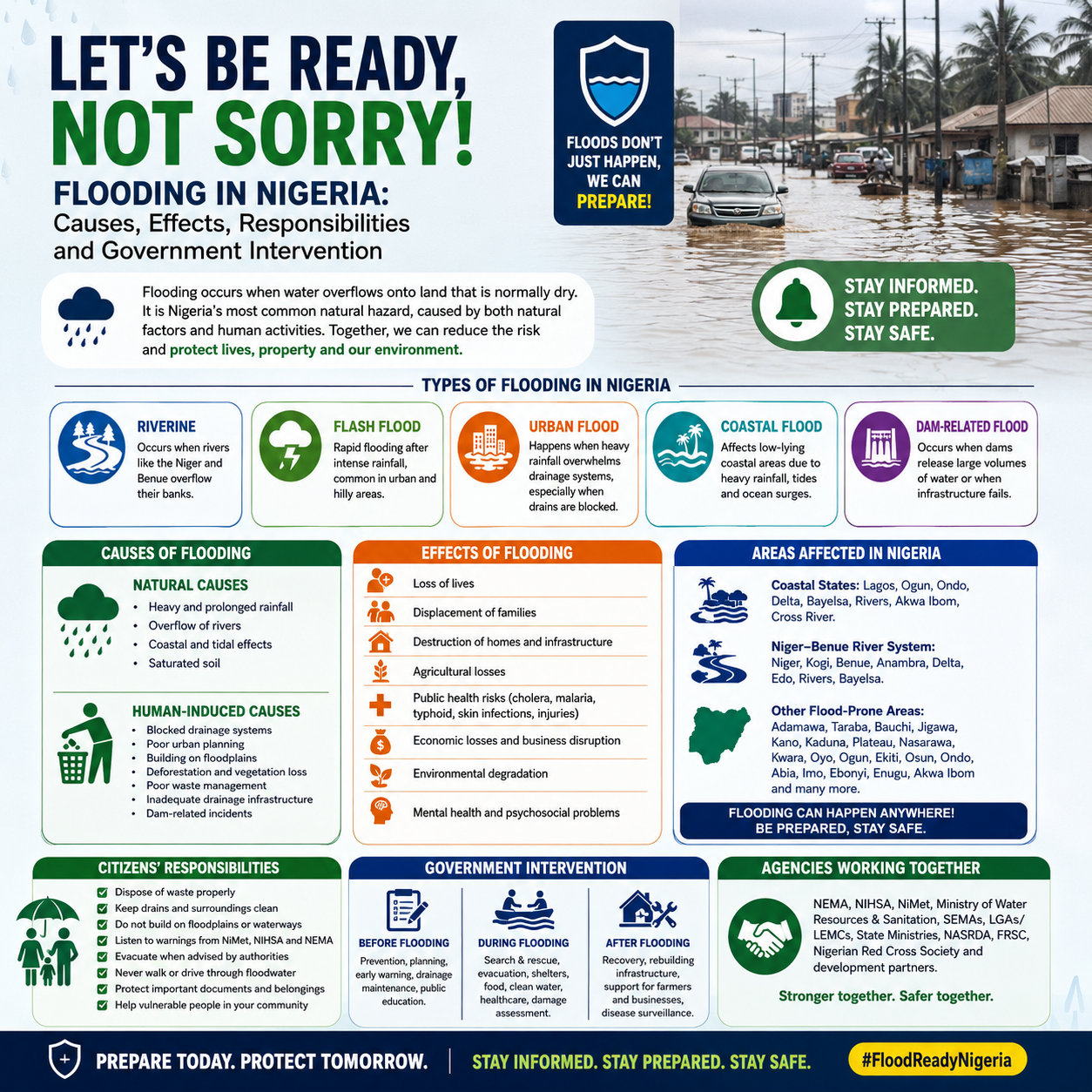
Flooding is one of Nigeria’s most recurring environmental and public-health hazards. It occurs when water accumulates on land that is normally dry, often because rainfall, river discharge, coastal water or surface runoff exceeds the capacity of the land and drainage systems to contain or carry it away. NEMA identifies flooding as Nigeria’s most common and widespread natural hazard. (NEMA Nigeria)
Nigeria’s flood problem is not caused by rainfall alone. Natural factors interact with human activities such as poor drainage, indiscriminate waste disposal, unplanned urbanisation, construction on floodplains and inadequate flood-control infrastructure. (NEMA Nigeria)
1. Flooding in Nigeria
Flooding in Nigeria can generally be grouped into:
- Riverine flooding – occurs when rivers such as the Niger and Benue overflow their banks.
- Flash flooding – rapid flooding following intense rainfall, particularly in urban and hilly areas.
- Urban flooding – occurs when rainfall overwhelms drainage systems, especially where drains are blocked or inadequate.
- Coastal flooding – affects low-lying coastal communities because of heavy rainfall, tidal influences and ocean surges.
- Dam-related flooding – can occur when dams release large volumes of water or when infrastructure fails.
Flooding is particularly serious because it can simultaneously become an environmental, economic, humanitarian and public-health crisis.
Nigeria’s 2026 Annual Flood Outlook provides flood-risk assessments across all 36 states and the FCT, using rainfall patterns, river levels and historical flood information to support preparedness. (nihsa.gov.ng)
2. Causes of Flooding in Nigeria
A. Natural causes
Heavy and prolonged rainfall:
Intense rainfall can produce more surface water than the soil, rivers and drainage systems can absorb or convey.
Overflow of rivers:
Rivers such as the Niger and Benue can overflow their banks, affecting communities located on floodplains.
Coastal and tidal effects:
Nigeria’s coastal communities are vulnerable because many areas are low-lying. Coastal flooding can be aggravated by heavy rainfall and ocean surges. (NEMA Nigeria)
Saturated soil:
After prolonged rainfall, the soil becomes saturated and can no longer absorb additional water effectively. This increases surface runoff and flash-flood risk. (NEMA Nigeria)
B. Human-induced causes
Blocked drainage systems:
Plastic waste, refuse, silt and other materials can obstruct drainage channels.
Poor urban planning:
Buildings and infrastructure constructed without adequate consideration of natural waterways and drainage patterns increase flood risk.
Building on floodplains and waterways:
Settlements constructed in areas naturally designed to accommodate excess water are highly vulnerable.
Deforestation and vegetation loss:
Removing vegetation reduces the ability of land to absorb and slow down rainwater, increasing runoff and erosion.
Poor waste management:
Dumping refuse into gutters, drains, streams and waterways prevents water from flowing freely.
Inadequate drainage infrastructure:
Some rapidly growing Nigerian cities have expanded faster than their drainage networks.
Dam-related incidents:
Dam releases or failures can contribute to severe flooding in downstream communities. NEMA’s 2024 reports, for example, documented flooding associated with the Alau Dam incident in Borno State. (NEMA Nigeria)
3. Effects of Flooding
A. Loss of lives
Floodwaters can drown people, sweep away vehicles and destroy buildings. Fast-moving floodwater is particularly dangerous.
B. Displacement
Families may be forced to leave their homes and move to temporary shelters or safer communities.
For example, NEMA’s 2024 national situation report recorded more than 1.3 million affected people and over 729,000 displaced persons across 34 affected states and 211 LGAs as of October 22, 2024. (NEMA Nigeria)
C. Destruction of homes and infrastructure
Floods can damage:
- Houses
- Roads
- Bridges
- Schools
- Hospitals
- Electricity infrastructure
- Water facilities
- Markets
- Telecommunications infrastructure
D. Agricultural losses
Flooding can destroy:
- Farmland
- Crops
- Livestock
- Fish ponds
- Farm equipment
- Stored agricultural products
This can contribute to food shortages and increased food prices.
E. Public-health problems
Flooding can contaminate drinking-water sources and create conditions favourable for the spread of waterborne and vector-borne diseases.
Potential health consequences include:
- Cholera and other diarrhoeal diseases
- Typhoid and other enteric infections
- Malaria
- Skin infections
- Injuries
- Mental-health and psychosocial problems
- Poor sanitation and hygiene conditions
NEMA specifically identifies cholera and other health-related problems among the consequences of flooding. (NEMA Nigeria)
F. Economic losses
Businesses may close temporarily or permanently. Transport can be disrupted, workers displaced and supply chains interrupted.
G. Environmental damage
Flooding can cause:
- Soil erosion
- Loss of vegetation
- Destruction of ecosystems
- Water contamination
- Increased sedimentation
- Coastal erosion
4. Areas Affected by Flooding in Nigeria
Flooding is not restricted to one geographical region. However, vulnerability is particularly high in riverine, coastal, low-lying and poorly drained areas.
Coastal states
These include:
- Lagos
- Ogun
- Ondo
- Delta
- Bayelsa
- Rivers
- Akwa Ibom
- Cross River
Nigeria’s National Disaster Response Plan identifies the coastal belt as particularly vulnerable because of its low elevation, heavy rainfall and exposure to ocean surge. (NEMA Nigeria)
Niger-Benue river system
Communities around the Niger and Benue river basins are particularly vulnerable to riverine flooding.
States that can be affected include:
- Niger
- Kogi
- Benue
- Anambra
- Delta
- Edo
- Rivers
- Bayelsa
NEMA has specifically issued flood warnings for downstream communities in states including Benue, Kogi, Anambra, Delta, Imo, Rivers and Bayelsa when river levels rise. (NEMA Nigeria)
Other flood-prone areas
Flood risk also occurs in parts of:
- Adamawa
- Taraba
- Bauchi
- Jigawa
- Kano
- Kaduna
- Plateau
- Nasarawa
- Kwara
- Oyo
- Ogun
- Ekiti
- Osun
- Ondo
- Abia
- Imo
- Ebonyi
- Enugu
- Akwa Ibom
Importantly, the northern part of Nigeria is not exempt from flooding. NEMA notes that even areas with relatively lower rainfall can experience annual flooding. (NEMA Nigeria)
In July 2026, for example, NiMet identified 26 states and the FCT as being at elevated risk of flash flooding during a particular 10-day period, demonstrating the broad geographical nature of the threat. (NEMA Nigeria)
5. Citizens’ Responsibility
Flood control is not solely a government responsibility. Individual and community behaviour can either increase or reduce flood risk.
Citizens should:
1. Stop dumping refuse in drains and waterways.
Blocked drainage is one of the preventable contributors to urban flooding.
2. Keep drainage channels around homes and businesses clear.
3. Avoid building on waterways and floodplains.
4. Pay attention to early-warning information.
Residents should follow flood forecasts and alerts from official agencies such as NiMet, NIHSA and NEMA.
5. Evacuate when instructed.
People should not wait until floodwater becomes dangerous before leaving high-risk areas.
6. Avoid walking or driving through floodwater.
Moving water can be deeper and stronger than it appears. NEMA specifically advises against driving or walking through floodwaters. (NEMA Nigeria)
7. Protect important documents and property.
Important documents, medicines, food and other essential items should be moved to safe locations when flooding is anticipated.
8. Participate in community sanitation and drainage activities.
9. Report blocked waterways and emerging flood hazards.
10. Help vulnerable people.
Children, older adults, persons with disabilities and people who are ill may require assistance during evacuation.
6. Government Intervention
Government intervention should operate at three stages: before, during and after flooding.
Before flooding — Prevention and preparedness
Government should:
- Construct and maintain adequate drainage systems.
- Desilt rivers, canals and drainage channels where appropriate.
- Develop and enforce proper urban planning regulations.
- Prevent illegal construction on waterways and floodplains.
- Strengthen flood forecasting and early-warning systems.
- Construct appropriate flood-control infrastructure such as levees and floodwalls where technically justified.
- Improve waste-management systems.
- Maintain dams and other water infrastructure.
- Conduct public education and community sensitisation.
- Develop evacuation plans and emergency shelters.
NEMA recommends measures including improved drainage, removal of debris and solid waste from drainage systems, and appropriate flood-control structures. (NEMA Nigeria)
During flooding — Emergency response
Government agencies should:
- Conduct search and rescue.
- Evacuate affected communities.
- Provide temporary shelters.
- Supply food, clean water and essential medicines.
- Provide emergency healthcare.
- Restore critical infrastructure.
- Assess damage and identify urgent needs.
- Coordinate humanitarian organisations and other responders.
NEMA has operational offices across the country and works with State Emergency Management Agencies to conduct assessments and rescue operations during flood emergencies. (NEMA Nigeria)
After flooding — Recovery
Government should:
- Rehabilitate damaged roads and bridges.
- Reconstruct homes and public infrastructure.
- Support affected farmers and businesses.
- Restore water and sanitation systems.
- Conduct disease surveillance.
- Review what went wrong.
- Strengthen flood-control measures before the next rainy season.
7. Bodies and Organisations Responsible for Flood Control in Nigeria
Flood management requires multiple agencies working together, rather than one organisation acting alone.
| Organisation | Major responsibility |
| NEMA – National Emergency Management Agency | National disaster preparedness, emergency response, coordination, rescue, relief and disaster-risk management |
| NIHSA – Nigeria Hydrological Services Agency | Hydrological monitoring, flood forecasting, river/water-level information and Annual Flood Outlook |
| NiMet – Nigerian Meteorological Agency | Weather forecasting, rainfall information and meteorological early warnings |
| Federal Ministry of Water Resources and Sanitation | Water resources policy, infrastructure and coordination within the water sector |
| State Emergency Management Agencies (SEMAs) | State-level disaster preparedness, response, relief and coordination |
| Local Government Authorities / LEMCs | Community-level preparedness, local response and coordination |
| State Ministries of Environment / Works / Water Resources | Drainage, environmental management, flood-control infrastructure and related state interventions |
| NASRDA – National Space Research and Development Agency | Satellite/remote-sensing information useful for environmental monitoring and flood mapping |
| FRSC – Federal Road Safety Corps | Road safety and emergency response, particularly where flooding disrupts transportation |
| Nigerian Red Cross Society | Humanitarian assistance, community preparedness, emergency response and support to affected populations |
| Development and humanitarian organisations | Relief, shelter, WASH, health, food assistance, community preparedness and recovery |
NEMA’s national disaster-management policy establishes it as the apex federal body for disaster management, responsible for coordinating disaster-management policies and strategies nationally. (NEMA Nigeria)
The importance of inter-agency coordination is increasingly recognised. In August 2026, NEMA convened agencies including NIHSA, NiMet and NASRDA to strengthen early warning and proactive flood management under the planned Early Warnings for All initiative. (NEMA Nigeria)
8. The Key Message
Flooding in Nigeria should not be viewed simply as “too much rain.” It is the result of the interaction between hazard, exposure and vulnerability.
A heavy rainfall event becomes a disaster when people, homes, roads, farms and critical infrastructure are located in vulnerable places and when drainage, planning, early warning and emergency-response systems are inadequate.
Therefore, effective flood management requires:
Forecasting → Early warning → Community preparedness → Proper urban planning → Drainage and waterway management → Environmental protection → Emergency response → Recovery and reconstruction.
Most importantly, government and citizens have complementary responsibilities. Government must provide effective planning, infrastructure, regulation, forecasting and emergency response, while citizens must avoid activities that worsen flooding, heed warnings, maintain their immediate environment and evacuate when necessary.
Nigeria already has important institutions and forecasting systems in place; the larger challenge is ensuring that warnings translate into early action and that flood-risk reduction happens before disaster strikes, rather than relying predominantly on relief after flooding has occurred. NEMA itself has emphasised the need to move from reactive response toward preparedness and coordinated early action. (NEMA Nigeria)